Wednesday, February 18, 2009

wuthering heights wrap-up / frankenstein intro

wuthering heights

-by the novel's end, catherine and nelly end up imprisoned in the house.  linton is sickly and feeble, very influenced by heathcliff and willing to sacrifice catherine —> in the end though linton is the one who lets catherine out of her room to talk to her father one last time (he still has no real character though).  hareton embraces his uncivilized upbringing (swears constantly and is encouraged by heathcliff), he grabs catherine's hair when she come to the heights like a child. this is b/c heathcliff ruins hareton, doesn't appreciate nelly and was labeled as a satanic character by one of bronte's sisters (also labeled emily's book as "great art")

frankenstein

-1819 & 1831 were years of 1st and 2nd edition of the book (huge differences b/t the 2, many prefer the earlier version).  the character of walton gives up trying to become homer after just 1 year (wants his name to be remembered, not to be a great writer).  and so, the novel starts off thru series of letters written by walton to his sister.  walton and his group gets stranded on their ship in the middle of icy region and they discover a sickly victor, who begins to tell his story on the creation of his monster to walton.  victor is motivated to tell walton his story b/c 
 of what we see in letter 4, 2nd paragraph near beginning of novel, " ... unhappy man, do you share my madness?" quote pulled from 1831 edition.  victor saw the same madness in walton's eyes as in his own.  victor and walton both share the same madness in wanting so badly to become famous and to leave a legacy (victor's story to walton is therefore a cautionary tale so walton does not make the same mistakes)

-sidenote, as for percy shelley, he wrote some of the best poetry in the english language, his novels however do not compare (especially to his wife's).

Monday, February 16, 2009

volume II of wuthering heights — class discussion

-heathcliff is justifiably angry w/ catherine for marrying edgar instead of him.  in one film version, daughter and mother are the same actress (a medium specific analysis of the story showing the closeness of love & hate).  the 1939 film version is a less harsh / cruel portrayal of catherine and heathcliff's relationship (they're kinder to each other)

-why would emily bronte want to darken romance? (maybe b/c of the appeal of realism, it's more likely to happen in real life —> being able to love 2 people @ the same time in totally diff. ways).  in some ways, the love narrative parallels 2 modern films, the notebook & sweet home alabama.  it is similar in the manner that marrying soulmate vs. marrying the person who is best fit for your social life (catherine's decision she has to make).  it is unfair to condemn catherine for wanting to retain both loves some could argue (although some claim she is unfair to edgar in marrying him for "empirical" reasons).

"the two faces of love in wuthering heights" by james phillips


-in order to gain a better understanding of not only the second half of wuthering heights, but also the novel as a whole, i chose to look at james phillips' essay on the 2 types of love he claims exist within bronte's story throughout between catherine and heathcliff.  his essay, published quite recently (july 2007), combines ideas of kant and freud in an effort to define the love that exists in the story — mainly between catherine and heathcliff vs. catherine and linton.

-while it starts off promising, it quickly begins to reach for an abstract analysis surely unintended by ms. bronte when she penned her novel over 100 years ago.  the fact that she died soon after finishing wuthering heights invites all sorts of intriguing literary analysis since she did not have much time to comment on her own work and her own authorial intent / views on and experience w/ romantic love.  in my view, phillips is nothing more than a participant in the idolatry of author worship (or intense analysis centuries after the fact).  whether phillips is right or wrong isn't important, what occurs is that bronte's name is immortalized thru his essay, which is rather annoying.

-phillips starts off by immediately creating a binary in which he forms his essay around.  "heathcliff is the transcendental face of love, linton is its empirical face" (96).  this is where he makes his first leap, and also his first mistake.  by limiting himself to kantian philosophy, there are only 2 classifications of love for him to label for heathcliff and linton respectively.  i am of the opinion that it is quite human nature to desire to classify things between 2 labels, one or the other.

-in phillips' defense, disregarding this supposed binary, immanual kant did lived and died before bronte was born (born 1724, died 1804 — bronte was not born until 1818).  thus, it is in the realm of possibility that she was in fact influenced by his ideas, but to what extent it is hard to say for certain.  phillips is purely speculating from the very beginning, a lofty goal and a fascinating concept, but a shot in the dark nonetheless.

-what he means w/ his labels is that catherine's love for heathcliff transcends normal ideas of love, it transcends other relationships she has, it transcends her death (she still communicates w/ him as a ghost), etc.  concerning linton, her love is empirically based, or grounded in what he literally brings to the table for her.  it's impermanent, which, traditionally, all love is considered to be.  this makes phillips question whether or not catherine and heathcliff's relationship was really love after all, which is far more interesting than borrowing kantian and freudian terms (which he does later by offering up a hypothesis that when heathcliff moved in w/ her family at a young age she didn't really see him as a brother but as a father in a strange sort of electra complex).

-looking further into whether or not their relationship was love in its truest sense, phillips examines the "trust" they have for one another.  "trust, too, looks beyond empirical data" (98).  but, catherine never has a vulnerable moment of faith (trust by definition is uncertain).  instead, "in catherine's eyes, there is no possibility of abandoning heathcliff, b/c the foundation of their bond in insensible to empirical reversals" (98).  thus, she doesn't feel bad as one normally would when she marries linton.  for her this is a whole different type of love entirely.

-for catherine and heathcliff, "the distinction b/t love and the object of love is erased" (98).  therefore, catherine's only idea of "true love" can only be represented (and also personified) via heathcliff, her one true love throughout her life and death.  this is how phillips defends catherine's cruelty aspects towards heathcliff in regards to her marriage w/ linton.  she is so confident in her relationship w/ heathcliff that she feels nothing can break their bond.  for her, heaven is hellish w/o heathcliff in it.  theirs is an obsessive relationship, but its intensity can be complimented and observed.

-heathcliff on the other hand has to have catherine die before realizing the old cliche: "you don't know what you got til it's gone."  basically, as phillips says, "love is not abstract" (102).  both heathcliff and catherine embody each other's idea of what love is, and they cannot separate each other from their idea of what love is.  it is an absolute, cruel, timeless love. ** so intense **

-finally, phillips questionably includes near the end of his essay a line that sabotages his own arguments.  quoting an essay on the novel as a whole, he recalls that its author, leavis, "discusses the dangers of the reductive reading whose focus os the relationship b/t catherine earnshaw and heathcliff"  (104).  leavis, assumedly a feminist, instead labels the 2nd half of the book and a look at an "alternative understanding of love and of woman" (104).  this analysis is much more conceivable, and likely, to me.  on top of that, phillips does nothing after this to defend his essay, which to me is just what leavis warns against doing.  perhaps phillips doesn't consider his to be so since it offhandedly also considers the question of catherine and linton's relationship.  however, it's obvious that his main concern here is w/ the novel's 2 principal lovers, namely, catherine and heathcliff.

-this essay did not necessarily help my understanding of the 2nd half of the novel, but it did open up my mind to a whole new set of ideas and ways of looking at wuthering heights in general and esp. w/ regard to catherine and heathcliff.  so, while i'm not buying everything phillips is selling, he does have some interesting ideas and poses some good questions.

Monday, February 9, 2009

wuthering heights thru ch. 14 discussion & plot sequence

-none of the characters are very nice —> even though catherine and heathcliff are very similar and appear to be "soulmates," they're really not any better off together.  in fact, they're almost worse off.  during the 1800's, especially in a secluded part of the country (like wuthering heights & thrushcross grange), servants were incredibly close to the ones they served.  it's also infantilizing for the ones being served (catherine develops into quite the narcissist).  nelly dean (servant) is the same age as hindley (catherine's brother) —> they used to be close as children until "class reared it's ugly head" and their relationship changed.  

-later, it works into heathcliff's plans for isabella to fall for him, but one gets the sense he would have gotten her to like him if for no other reason than his own twisted satisfaction.  heathcliff is jealous of catherine's marriage to edgar.  he feels she should be his husband and not edgar's.  "i have a right to kiss her, if she chooses, and you have no right to object—i'm not your husband, you needn't be jealous of me!" says heathcliff to catherine (ch. 11, pg. 99).  heathcliff's marriage to isabella follows the logic of "you take my girl, i'll take yours" w/ regards to his competition w/ edgar for catherine's hand.

-hindley was the one who degraded heathcliff in catherine's eyes so she no longer saw it fit to marry heathcliff (although heathcliff made little to no effort to move up in class status) "i've no more business to marry edgar linton than i have to be in heaven," says catherine to nelly (ch. 9, pg. 71).  heathcliff comes back 3 years later to wuthering heights and systematically takes back the estate from hindley thru gambling (unbeknownst to hindley).  as for hareton, when he observes heathcliff abuse his father he takes pleasure from it, since hindley has always mistreated him as a child.  heathcliff's desire to torture others stems from his being tortured by catherine—> he no longer takes pleasure in anything other than seeking revenge on those who have wronged him.  heathcliff also hopes to take catherine's money (she would inherit hindley's remaining fortune)

-catherine dies after having her baby, but before she dies she goes insane (edgar isn't around, she hasn't eaten and hindley doesn't take care of her)—>heathcliff has taken away everything that is dear to her.  to laura, a soulmate is someone who is very close to you but can disagree w/ you.  the love between heathcliff and catherine is somewhat oppressive (neither can live w/o the other, in a certain way).  that makes them not really true soulmates.  after catherine dies, heathcliff feels his soul has gone into the grave (his hopes for happiness die w/ catherine).


Friday, February 6, 2009

wuthering heights cont'd (heathcliff description and class notes, thru ch. 11)


heathcliff description

-heathcliff is generally unhappy and it shows.  he's also obsessive (with regards to catherine, and her ghost), ill-tempered (towards everyone) and cruel (towards hareton and little catherine as well as zillah).  he is a horribly unpleasant, borderline sociopathic older man now.  heathcliff is brutally stoic and has his guard up 24/7.  the one instance so far of his showing any signs of weakness is after he discovers lockwood in the hidden chamber inside wuthering heights that zillah showed him too.  the room of course is haunted by catherine.

"come in!  come in!" he sobbed.  "cathy, do come.  oh do— once more!  oh!  my heart's darling, hear me this time —catherine, at last!" (pg. 24).

-lockwood describes the scene using words like "anguish" and "grief."  it is clear heathcliff put much of his hopes into catherine long ago.  mr. earnshaw (catherine's dad) was the one who brought heathcliff into their home to begin with (he was nothing more than a gipsy baby in the streets w/ no home).  catherine's brother hindley was extremely abusive towards heathcliff growing up, but he was okay w/ that as long as he got what he wanted (his horse, catherine's affections).  his emotionally and physically abusive upbringing shaped his adult personality.

class notes (sequence of events from ch's 3-10 + analysis)

-ch.9 catherine feels she should marry edgar (not heathcliff) b/c it would ruin her name
"it would degrade me to marry heathcliff, now; so he shall never know how i love him; and  that, not because he's handsome, nelly, but b/c he's more myself than i am" —> heathcliff  hears catherine say this (but not the part about her loving him), gets up and leaves

-catherine feels she's more herself around heathcliff and she's feels physically stronger and has more fun w/ heathcliff.  despite this, instead, catherine goes off and marries edgar for her reputation's sake (she really conformed to social expectations).  bronte does a good job of creating real characters (& moral ambiguity), which clouds who is right and who is wrong —> partial explanation for why critics have had so much difficulty pinning down definitive analyses of the book, it's so authentic.

-three years into catherine and edgar's marriage, heathcliff returns and is rich (catherine is grateful for this) —> then isabella falls in love w/ him (they later marry).  hindley ends up being a drunkard who gambles all his $ away to heathcliff.  nelly in ch. 11 talks about going up to wuthering heights and visiting hareton to save him from his horrible upbringing (nelly dean is now the narrator).

Wednesday, February 4, 2009

emily bronte's wuthering heights (chapters 1-2)


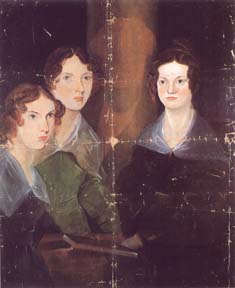
-the bronte sisters (charlotte, emily and anne; pictured above) were a talented bunch of british women writers and all published their works under male pen names (charlotte wrote jane eyre).  emily published wuthering heights in 1847 and died just 1 year later @ age 30.  over 100 years later, emily bronte was called a "female shakespeare" (she was finally fully acknowledged for her talents)

-chapter 1 of wuthering heights starts off w/ mr. lockwood as narrator, whose new landlord is heathcliff.  the setting of the novel, including heathcliff's estate, is "a perfect misanthropist's heaven" (according to lockwood).  lockwood recalls an earlier failed romantic adventure when he was on vacation on the coast: he discovers a "real goddess in my eyes" and claims it was painfully obvious he liked her.  she returns his gazes (believing he's interested in her, which he is).

-BUT, instead of making a move, he "at every glance retired colder and farther."  the time this is all taking place in is 1801, making heathcliff c. 37 yrs. old.  readers can gain insight into heathcliff's personality thru his treatment of his dogs (he is extremely brutal to people and his pets, although he claims that's not what his dogs are there for).

Monday, February 2, 2009

did bungle commit rape?


yes.

-dibbell (the author) did a good job of converting me.  it doesn't matter whether it was in the virtual MOO world or not.  what matters is when you violate an adult woman so badly she has "posttraumatic tears streaming down her face."  bungle WAS being a "fuckhead."  how messed up in the head do you have to be to log onto LambdaMOO from NYU and publicly mutilate / terrorize multiple people on the other side of the country?  the fact that bungle chose to bring other MOO users into the living room to commit these gross acts shows his viciousness.  and to those who don't believe a rape can occur online, remember the whole concept of cyber-sex.  it's real.  people do it.  "sex is never so much an exchange of liquids as it is an exchange of signs," writes dibbell.  i admit i'm immediately turned off by anything remotely resembling world of warcraft, but this bungle guy really was a WEIRDO.  his reappearance as dr. jest only added to the eeriness.  i'm glad JoeFeedack toaded his ass.  what a creep.

what the class says...
-there are things that are absolutely life altering in made-up worlds (like watching a clockwork orange or psycho).  in a virtual world, you have an emotional investment in your character.  megan meier is the most messed up case study in this debate (she was the 13 yr. old who committed suicide after her neighbor / ex-friend, w/ the help of her mom created a fake myspace boyfriend, asked meier out, broke up w/ meier, called her "fat," a "slut," and told her the world would be a better place w/o her).